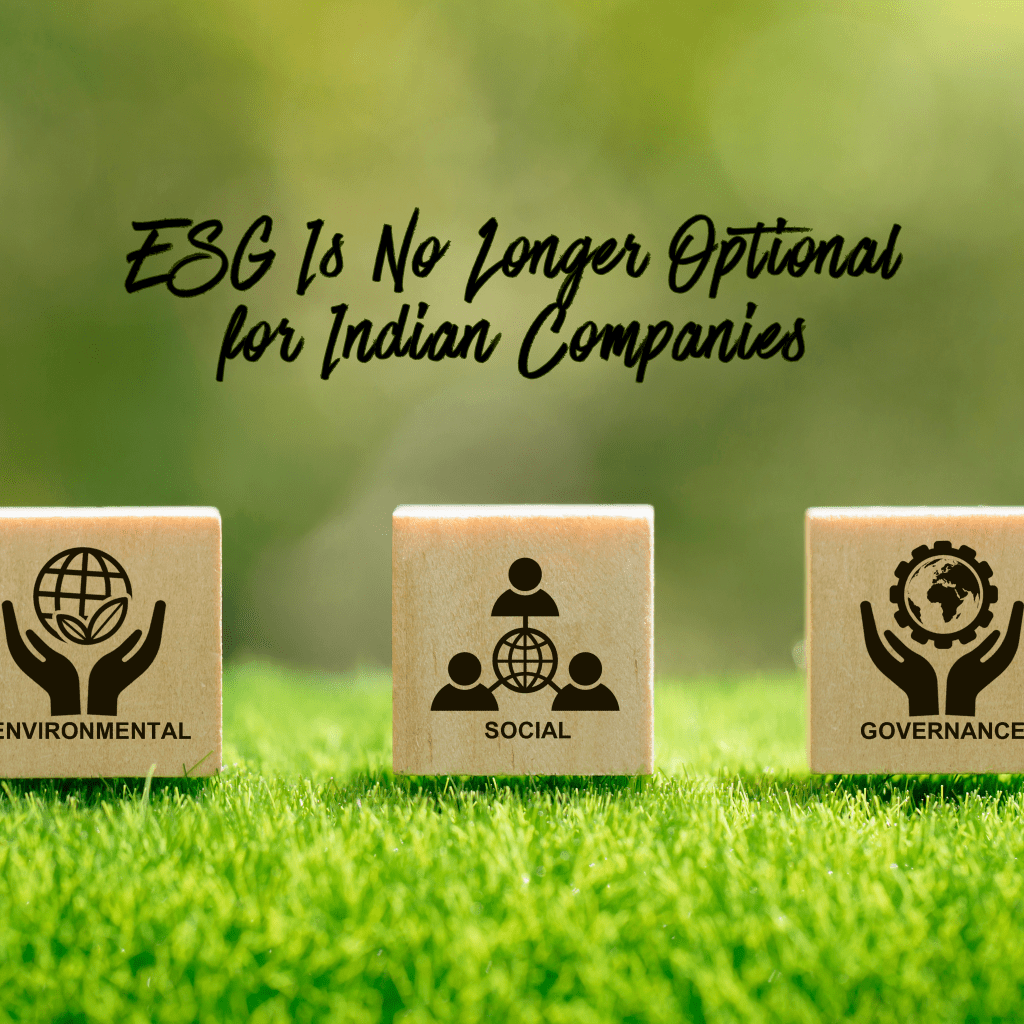
For most of the last decade, ESG was a conversation that Indian companies had voluntarily. Environmental commitments, social impact disclosures, and governance transparency were things that progressive companies did to signal values, attract international investors, and differentiate themselves in a crowded market. Most companies did not do them at all.
That era is ending.
ESG reporting in India is moving from optional best practice to regulatory requirement at a pace that many corporate leaders have not fully registered. The changes that are already in place, and the ones that are coming in the next two to three years, will affect how Indian companies disclose information, how they are evaluated by investors and lenders, and how they design their CSR and sustainability programs.
I have spent years working at the intersection of CSR, sustainability, and corporate partnerships in India. The shift I am seeing in how companies are approaching ESG is real and it is accelerating. This article is an honest breakdown of what is happening, why it is happening, and what it means for Indian companies right now.
What ESG Actually Means Before We Go Further
ESG stands for Environmental, Social, and Governance. It is a framework for evaluating how a company manages its impact and responsibilities across three dimensions.
1. Environmental covers how a company manages its impact on the natural world. This includes carbon emissions and climate risk, energy consumption and efficiency, water usage and conservation, waste generation and management, biodiversity impact, and supply chain environmental practices.
2. Social covers how a company manages its relationships with people. This includes employee welfare and workplace safety, diversity and inclusion, community impact and CSR programs, supply chain labor standards, customer data privacy, and engagement with the communities in which the company operates.
3. Governance covers how a company is led and controlled. This includes board composition and independence, executive compensation transparency, anti-corruption policies, shareholder rights, audit quality, and internal controls.
ESG is not the same as CSR, though the two are related. CSR in India is a statutory spending requirement under the Companies Act 2013. ESG is a broader disclosure and management framework that covers how a company’s entire business operates across environmental, social, and governance dimensions, not just how it spends a mandated percentage of its profits on social programs.
Why ESG Reporting Is Becoming Mandatory in India
1. SEBI’s Business Responsibility and Sustainability Report
The single most significant regulatory development in Indian ESG reporting is the Securities and Exchange Board of India’s Business Responsibility and Sustainability Report, known as the BRSR. SEBI made BRSR mandatory for the top 1,000 listed companies by market capitalization from financial year 2022 to 2023 onwards.
The BRSR replaced the earlier Business Responsibility Report and is significantly more comprehensive. It requires companies to disclose detailed information across all three ESG dimensions including:
- 01. Energy consumption and intensity
- 02. Water withdrawal and consumption
- 03. Greenhouse gas emissions including Scope 1 and Scope 2
- 04. Waste generation and management
- 05. Employee health, safety, and welfare metrics
- 06. Supply chain sustainability practices
- 07. CSR spending and impact
- 08. Board diversity and governance structures
- 09. Stakeholder engagement practices
- 10. Complaints and grievance mechanisms
This is not a checkbox exercise. The BRSR requires specific, quantified disclosures with data points that companies must collect, verify, and report annually. Organizations that have not built the internal systems to track these metrics are finding the BRSR a significant operational challenge.
2. BRSR Core and Assurance Requirements
SEBI took the ESG reporting mandate a step further by introducing BRSR Core, a subset of key performance indicators from the BRSR for which listed companies must obtain reasonable assurance from an external auditor.
The assurance requirement fundamentally changes the nature of ESG disclosure. A company can write whatever it chooses in an unverified sustainability narrative. A company whose ESG disclosures are subject to external assurance must be able to demonstrate the accuracy of those disclosures with supporting data and documentation. This raises the bar for ESG reporting quality across the board and creates accountability that voluntary disclosure frameworks never produced.
3. Global Regulatory Pressure Through International Standards
Indian companies with international operations, international investors, or international supply chain relationships are facing ESG disclosure requirements from multiple directions simultaneously.
01. The European Union’s Corporate Sustainability Reporting Directive requires companies operating in or supplying to the EU market to meet detailed sustainability disclosure standards. Indian exporters and companies with European customers are directly affected.
02. The International Sustainability Standards Board has published global baseline standards for sustainability disclosure that are being adopted by regulators in multiple jurisdictions. As India moves toward alignment with global standards, ISSB frameworks are likely to influence future iterations of Indian ESG regulation.
03. International investors and foreign institutional investors who hold significant stakes in Indian listed companies are applying their own ESG screening criteria to investment decisions. Companies that cannot demonstrate credible ESG performance are increasingly facing pressure on their access to international capital.
4. RBI Guidelines for Banks and Financial Institutions
The Reserve Bank of India has issued guidelines requiring banks and financial institutions to integrate climate risk into their risk management frameworks and to disclose climate-related financial risks. This has direct implications for Indian companies because lenders are beginning to factor ESG performance into credit decisions.
A company with poor environmental disclosures or documented governance failures is a company with higher risk in the eyes of a lender that is applying climate and ESG risk frameworks. As these guidelines deepen and as lenders build the capacity to assess ESG risk systematically, ESG performance will increasingly affect the cost and availability of credit for Indian companies.
5. Stock Exchange Requirements
Both the Bombay Stock Exchange and the National Stock Exchange have incorporated ESG-related requirements into their listing obligations. These requirements complement SEBI’s BRSR mandate and create additional accountability mechanisms for listed companies through exchange-level monitoring and enforcement.
What This Means for Different Types of Indian Companies
For Large Listed Companies
01. BRSR compliance is already mandatory and BRSR Core assurance requirements are being phased in. Large listed companies need to have robust ESG data collection, verification, and reporting systems in place now.
02. Board-level ESG oversight is no longer optional. Directors need to understand ESG risk and disclosure requirements well enough to provide meaningful oversight rather than rubber-stamping management reports.
03. ESG performance is increasingly a factor in how institutional investors, proxy advisors, and credit rating agencies evaluate these companies. Poor ESG disclosure or documented ESG failures have measurable consequences for stock price, credit rating, and access to capital.
04. Supply chain ESG requirements are flowing downward. Large listed companies under pressure to disclose their supply chain sustainability practices are beginning to ask their suppliers for ESG information, which means ESG requirements are extending beyond listed companies to their entire supplier ecosystem.
For Mid-Sized and Unlisted Companies
01. While mandatory BRSR requirements currently apply only to the top 1,000 listed companies, the trajectory is clear. SEBI has signaled intent to extend mandatory sustainability reporting to a broader universe of companies over time.
02. Unlisted companies with listed customers or listed investors are already facing indirect ESG pressure through supply chain and portfolio reporting requirements.
03. Companies preparing for an IPO need to have credible ESG practices and disclosure capability in place before they list. ESG due diligence is now a standard part of IPO preparation for companies targeting institutional investors.
04. Companies in sectors with significant environmental impact including manufacturing, chemicals, textiles, and energy are facing sector-specific regulatory attention that is likely to intensify regardless of listing status.
For Startups and Growth Stage Companies
01. ESG is increasingly a factor in venture capital and private equity investment decisions, particularly from funds with international LPs who apply ESG screens to their portfolio companies.
02. Building ESG practices early is significantly less costly and disruptive than retrofitting them later. Startups that embed environmental and governance practices from the outset are better positioned for growth stage funding and eventual public market access.
03. ESG-aligned founding narratives and business models are becoming a genuine competitive advantage in talent markets where younger professionals increasingly prefer to work for companies with credible sustainability commitments.
Where CSR Fits Into the ESG Picture
One of the most common sources of confusion in Indian boardrooms is the relationship between CSR compliance and ESG reporting. They are related but they are not the same thing and one does not substitute for the other.
CSR in India is a statutory spending requirement. Eligible companies must spend two percent of their average net profit on Schedule VII activities and report that spending annually. CSR compliance proves that a company spent money on social programs. It does not demonstrate how the company manages its environmental impact, how it treats its employees, or how its board makes decisions.
ESG reporting is a disclosure framework that covers all of this and more. A company with a perfect CSR compliance record can still have poor ESG performance if its manufacturing processes generate significant pollution, its supply chain relies on exploitative labor practices, or its board lacks independence and diversity.
Conversely, a company with strong ESG performance in its core operations, genuine environmental management systems, excellent employee welfare practices, and transparent governance will find that its CSR programs are one component of a broader and more credible sustainability story.
The companies that are navigating this transition most effectively are the ones that have stopped treating CSR as a separate compliance function and started integrating social and environmental responsibility into how they actually run their business. That integration is what ESG reporting ultimately measures and what investors and regulators are increasingly demanding evidence of.
What Indian Companies Should Be Doing Right Now
Based on where regulation is heading and what leading companies are already doing, here is what Indian companies should be prioritizing:
01. Build ESG data infrastructure. Start collecting the data that ESG reporting requires before the reporting deadline arrives. Energy consumption, water usage, emissions, waste generation, employee metrics, and supply chain information all need systematic collection systems.
02. Conduct a materiality assessment. Identify which ESG issues are most significant for your specific business, sector, and stakeholder base. Materiality assessment is the foundation of credible ESG reporting and helps companies focus their efforts where they matter most.
03. Align CSR with ESG strategy. CSR spending should reflect and reinforce the company’s broader ESG commitments rather than existing as a separate compliance function. Companies whose CSR programs directly address material ESG issues create more coherent and more credible sustainability narratives.
04. Invest in board and leadership ESG literacy. ESG oversight is a board responsibility. Directors and senior leadership need to understand ESG well enough to provide meaningful governance rather than delegating it entirely to a sustainability manager.
05. Engage implementation partners with ESG credibility. For CSR and community development programs that contribute to the social dimension of ESG, partnering with organizations that have strong documentation standards, verified impact measurement, and credible track records strengthens the quality of ESG disclosure.
06. Prepare for assurance. BRSR Core assurance requirements mean that ESG disclosures need to be supportable with evidence. Build documentation practices now that will withstand external auditor scrutiny.
07. Monitor regulatory developments continuously. ESG regulation in India is evolving rapidly. What is voluntary today may be mandatory within two years. Staying ahead of regulatory developments is significantly easier and less costly than scrambling to comply after a mandate arrives.
Conclusion: ESG Is Not Coming. It Is Already Here.
The question for Indian companies is no longer whether ESG reporting will become mandatory. For a large and growing proportion of Indian companies it already is. The question is whether companies are building the systems, the culture, and the practices that will allow them to meet those requirements credibly, not just on paper but in substance.
The companies that treat ESG as a genuine management framework rather than a disclosure exercise will be the ones that benefit most from this transition. They will attract better capital, better talent, and better partners. They will face lower regulatory risk. And they will be better positioned to operate in a world where the environmental and social consequences of business decisions are increasingly visible, increasingly measured, and increasingly consequential.
India’s corporate sector has the talent, the ambition, and in many cases the genuine values to lead on ESG rather than simply comply with it. The regulatory environment is creating the accountability structures that will separate the leaders from the laggards.
The time to build those practices is now, not when the next compliance deadline arrives.
If your organization is working to align its CSR programs with its broader ESG strategy and wants an implementation partner with documented impact standards and credible on-ground experience, Marpu Foundation is available to support that work.
Write to raghu@marpu.org, call 7997801001, or visit www.marpu.org to start the conversation.
 KADIRI RAGHU VAMSI
Leave a comment