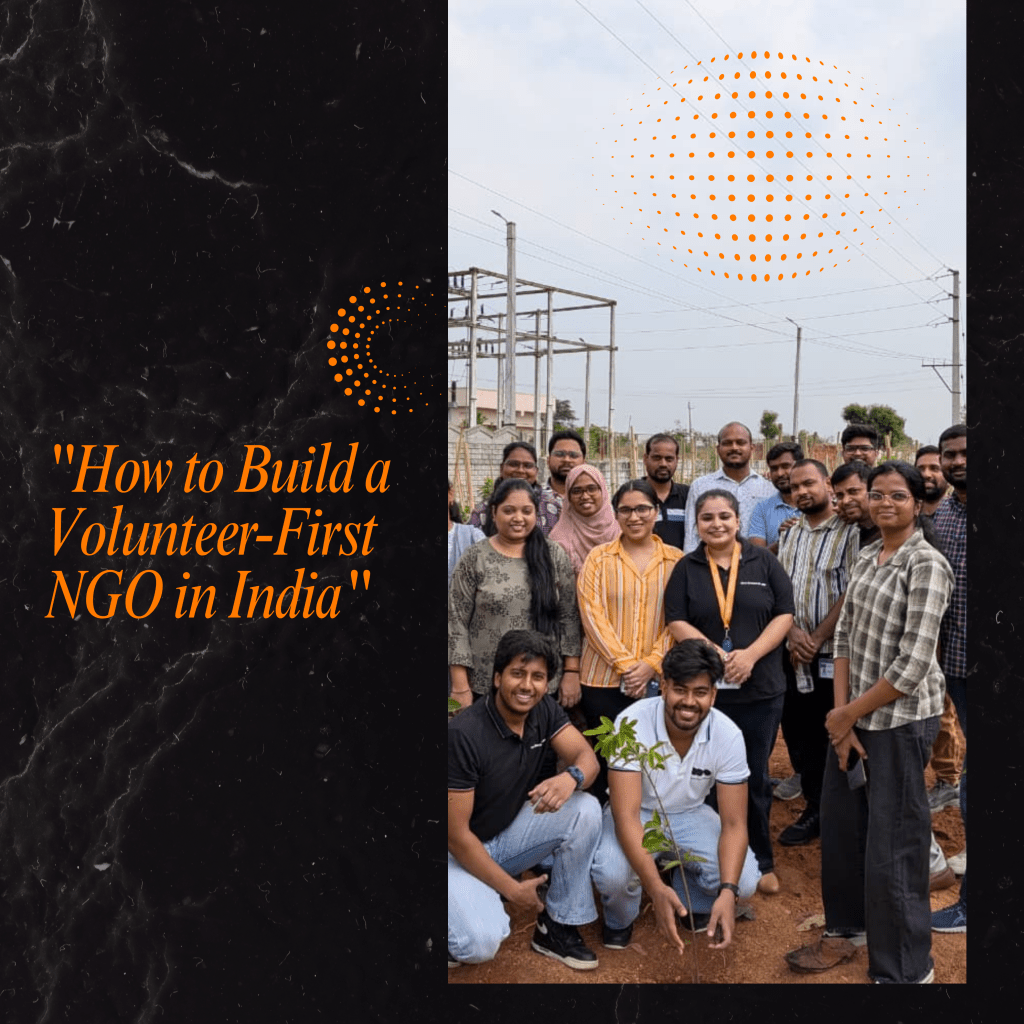
When I started Marpu Foundation, I did not have the vocabulary to describe what I was trying to build.
I knew I did not want to run an NGO that depended on a few full-time staff doing all the work and depending on grant cycles to pay them. I knew I did not want to chase foreign funding or build the kind of organisation that lived or died by the next funder’s mood. I knew I wanted communities to feel that they were part of the work, not just recipients of it. And I knew I wanted other young people, students, professionals, citizens, to have a real way to contribute their time, their skills, and their energy to something that mattered.
It took years to put a name to what I was building. Today the description that fits is volunteer-first. An NGO where volunteers are not extras who help on the side, but the core architecture of how the organisation operates. Where the staff exist to mobilise, coordinate, train, and support volunteers, not to do all the work themselves. Where the model is designed from day one to compound through people who choose to give their time, rather than through money raised year after year.
This article is the honest playbook for building a volunteer-first NGO in India. The philosophy that has to be right before any operational design works. The structural choices that make volunteer-first work in practice. The mistakes founders make that quietly turn a volunteer-first NGO into a conventional one. And what I have learned across the years of getting some of this right and some of it wrong.
What Volunteer-First Actually Means
Before any structure, the philosophy has to be clear.
Volunteer-first does not mean unpaid labour as a cost-saving strategy. That is exploitation dressed up in a friendly word. It does not mean asking volunteers to do work that should be the responsibility of paid staff or professional partners. It does not mean treating volunteers as free workers and the organisation as a transactional engine.
Volunteer-first means designing the organisation around the truth that millions of people in India would genuinely contribute their time and energy to causes they care about if given a real way to do so. The NGO’s job is to be that real way. To make the contribution meaningful, the experience respectful, the work genuinely useful, and the impact visible.
When this philosophy is in place, the operational design follows. When the philosophy is wrong, no operational design fixes it. Founders who start with volunteer-first as a cost-saving frame end up building organisations that fail both their volunteers and their communities. Founders who start with volunteer-first as a respect-and-mobilisation frame build organisations that compound for decades.
Why Volunteer-First Works in India Specifically
A few features of the Indian context make volunteer-first a particularly powerful model here.
The young population is large and engaged. India has one of the largest young populations in the world, and many of these young people are actively looking for purpose, experience, and ways to contribute. The supply of potential volunteers is genuinely enormous.
Civic culture has a strong tradition of voluntary contribution. Voluntary contribution to community and cause is not new to India. The volunteer-first model taps into a tradition that existed long before the modern NGO sector and continues to be culturally normal.
Corporate volunteering has become structural. Companies under Section 135 of the Companies Act increasingly run employee volunteering programmes alongside their CSR spend. A volunteer-first NGO that partners well with corporate volunteering teams can serve both the company and the community at the same time.
Costs are lower for volunteer-led models. A volunteer-first NGO can operate at a fraction of the cost of an equivalent professional-staff-led model, which makes the organisation more resilient and more sustainable over time. Lower running costs mean less pressure to chase funding constantly.
These four conditions together make volunteer-first a model that fits India specifically. The same model might be harder to scale in contexts where these conditions do not hold.
The Structural Choices That Make Volunteer-First Work
Beyond the philosophy, certain structural choices separate organisations that genuinely run on volunteer energy from those that claim to but actually depend on a small paid team.
Design Volunteer Roles as Real Contributions, Not Filler Work
The single biggest determinant of whether a volunteer comes back is whether the work they did felt meaningful.
Many NGOs treat volunteers as a way to staff one-day events and handle low-value tasks. Photo-op visits to schools. Single plantation drives. Bag-stuffing for camps. The volunteer leaves feeling used, not valued, and rarely returns.
Strong volunteer-first NGOs design volunteer roles that genuinely matter. Volunteers teach. Mentor. Coordinate. Lead local activities. Document and report. Train newer volunteers. Connect their professional skills to specific organisational needs. The roles are real, the contribution is visible, and the volunteer leaves having actually done something.
When designing volunteer roles, ask: would this role be valuable to the organisation even if a paid employee did it? If yes, the role is real. If no, the role is filler.
Build Layered Structures of Volunteer Leadership
A volunteer-first NGO cannot run if every decision flows through a small staff team. The organisation has to develop layers of volunteer leadership.
Strong programmes build local leads, area coordinators, city captains, and thematic leads from within their volunteer base. These layered volunteer leadership roles take ownership of activities, coordinate other volunteers, and reduce the bottleneck on staff. They also create growth paths within the organisation that retain volunteers for years.
A volunteer who starts as a participant and becomes a local lead three years later is a volunteer for life. An organisation full of these journeys is structurally resilient in ways no paid organisation can match.
Invest in Volunteer Training and Development
Volunteers need training to do real work well. Underinvesting in training is the most common reason volunteer programmes produce poor outcomes.
Strong volunteer-first NGOs train their volunteers properly. Orientation on the organisation and the work. Skill training for specific roles. Ongoing development for those who take on leadership responsibilities. Safety and protocol training for sensitive activities.
This investment is real. It takes time from senior people. It costs in materials and infrastructure. But it is what separates volunteer programmes that produce shallow impact from those that produce deep impact. The training also strengthens retention because volunteers value organisations that invest in them.
Use Paid Staff as Mobilisers, Not Workers
The role of paid staff in a volunteer-first NGO is different from their role in a conventional one.
In a conventional NGO, paid staff do most of the work. Programmes are run by employees. Volunteers help around the edges.
In a volunteer-first NGO, paid staff exist to mobilise, coordinate, train, support, and document the work that volunteers do. The staff member’s value is measured by how much volunteer capacity they unlock, not by how much they do themselves. A strong staff member in a volunteer-first organisation can coordinate ten volunteers who together produce ten times the impact of a single employee doing the work alone.
This is a different mindset, and not every potential employee fits it. Hiring for a volunteer-first organisation means looking for people who get energy from mobilising others, not people who want to do everything themselves.
Build Communities, Not Just Activities
A volunteer who attends activities and goes home is a participant. A volunteer who feels part of a community comes back, brings others, and stays for years.
Strong volunteer-first NGOs deliberately build community among their volunteers. Group activities that include time for connection. WhatsApp or other community channels where volunteers stay in touch between events. Recognition systems that celebrate contributions. Annual gatherings or events where volunteers across geographies meet each other.
Community is what compounds. A community of 100 engaged volunteers who feel they belong is worth more than a database of 1,000 volunteers who attended one event.
Create Local and Skills-Based Pathways
Different volunteers want to contribute in different ways. A volunteer-first NGO offers multiple pathways for different kinds of contribution.
Local volunteering for people who want to do hands-on work in their own city or neighbourhood. Skills-based volunteering for professionals who want to contribute their expertise remotely. Family-inclusive activities for those who want to involve their children. Youth-focused programmes for students. Senior-focused engagement for retirees.
Each pathway brings a different kind of volunteer. Together, they create a base broader than any single pathway could.
A Note on Volunteer Safety and Screening
While the model is built on welcoming volunteers, there is one area where care matters more than openness. Volunteer screening and safety.
A volunteer-first NGO that works with children, vulnerable communities, or in sensitive settings has a real responsibility to screen volunteers appropriately and to set clear conduct expectations. This is not about making the organisation harder to join. It is about protecting the people the organisation exists to serve, and protecting the volunteers themselves.
Basic processes matter. Understanding who volunteers are. Appropriate checks for any work involving children. Clear codes of conduct. Supervision in sensitive settings. These are non-negotiable, regardless of how much pressure there is to grow the base quickly.
Responsible screening protects the NGO’s reputation, the communities it serves, and the long-term trust the organisation depends on. No growth goal is worth compromising it.
The Operational Design That Holds It Together
Beyond the structural choices, certain operational systems are essential.
Documentation discipline from day one. Volunteer attendance, hours, activities, impact, and feedback all need to be captured systematically. Without this, the organisation cannot demonstrate impact to partners, track engagement, or learn from its own work.
Technology that scales with the base. A volunteer-first NGO outgrows spreadsheets quickly. Investing in basic volunteer management technology early prevents operational chaos as the base grows.
Clear communication systems. Volunteers need to know what is happening, when, and how to participate. Strong communication systems are not optional.
Financial systems that support volunteer-led work. Reimbursement processes, basic infrastructure, and travel support for volunteer leaders all need to be operationally clean. Volunteers should not be out of pocket for contributing their time.
Governance that reflects the volunteer-first identity. Boards, advisory committees, and decision-making processes should include voices from the volunteer base, not just staff and founders.
Common Mistakes Founders Make
A few patterns quietly turn volunteer-first NGOs into conventional ones.
Confusing volunteer-first with unpaid labour. When the philosophy slips into using volunteers as free workers, both the volunteers and the work suffer.
Underinvesting in volunteer experience. Volunteers who feel used leave. The investment in their experience is what keeps them.
Skipping volunteer leadership development. Without layered leadership, the organisation hits a capacity ceiling that no amount of volunteer recruitment can break.
Hiring staff who want to do the work themselves. Staff who see volunteers as helpers rather than as the core architecture undermine the model from within.
Treating volunteers as a number rather than as people. Headline volunteer counts are vanity metrics. What matters is the depth of contribution, the retention, and the lived experience of being part of the organisation.
Skipping safety and screening to grow faster. Growth without responsibility creates risks that eventually surface and damage everything that was built.
What Volunteer-First Looks Like When It Works
When volunteer-first works, the organisation looks different from a conventional NGO.
Activities run because local volunteer leaders make them happen, not because staff orchestrated every detail. Programmes scale across geographies because volunteers in each location take ownership of their region. New initiatives launch because volunteers identify needs and bring them forward. The organisation feels like a community rather than an employer.
Costs are lower per unit of impact, because the model leverages voluntary contribution rather than paying for every hour of work. This makes the organisation more resilient to funding cycles and less dependent on a few large funders. The independence is real, and it protects the organisation’s ability to do the work it believes in rather than only the work funders want.
The community impact compounds across years because volunteers who started as participants are now leaders, mentors, and ambassadors. The depth of engagement creates outcomes that money alone cannot produce.
A Realistic Note on Time Horizons
Building a volunteer-first NGO takes years, not months.
The first year, you are mostly running activities with the people closest to you and learning what works. The second year, you start to see the first wave of repeat volunteers and early leadership emerging. The third year, you begin to see the compounding effect, as early leaders bring others, as the community starts to feel real, and as the operational systems mature.
Most of the meaningful growth in a volunteer-first NGO happens after year three. Before that, the work is foundational, and the visible results are smaller. Founders who expect a million-volunteer network in year two will be disappointed and may give up too early.
The outcome also depends on factors beyond the founder’s control. The cause has to be one people genuinely want to contribute to. The geography has to support the model. The founder’s network and persistence matter. Luck plays a role. None of this should discourage founders, but all of it should temper expectations.
What I can say is that volunteer-first is genuinely possible. Marpu Foundation grew into a network across 23 states with more than a million volunteers, working alongside more than 250 corporate partners, without foreign funding, and largely without paying for recruitment. The model works when the philosophy is right, the structure is sound, and the patience is real.
Why Volunteer-First Matters for the Long Term
Beyond what it does for any single NGO, volunteer-first matters for the Indian social sector as a whole.
It builds a base of people who have personally participated in social impact work, which deepens civic culture in ways no purely professional NGO can. It creates pathways for young people to engage with causes and develop into the next generation of social sector leaders. It reduces the sector’s dependence on foreign funding and external grant cycles, which strengthens the autonomy of Indian organisations. And it demonstrates a model that other founders can adapt to their own causes.
If you are a founder considering this path, you are building something that matters beyond your own organisation. The model itself is a contribution.
That is what I have learned in the years of building Marpu, and what I hope this article gives you the language and the structure to build for your own cause.
If you are building an NGO and considering a volunteer-first model, I am happy to share more from my experience. Write to me at raghu@marpu.org.
 Kadiri Raghu Vamsi
Leave a comment