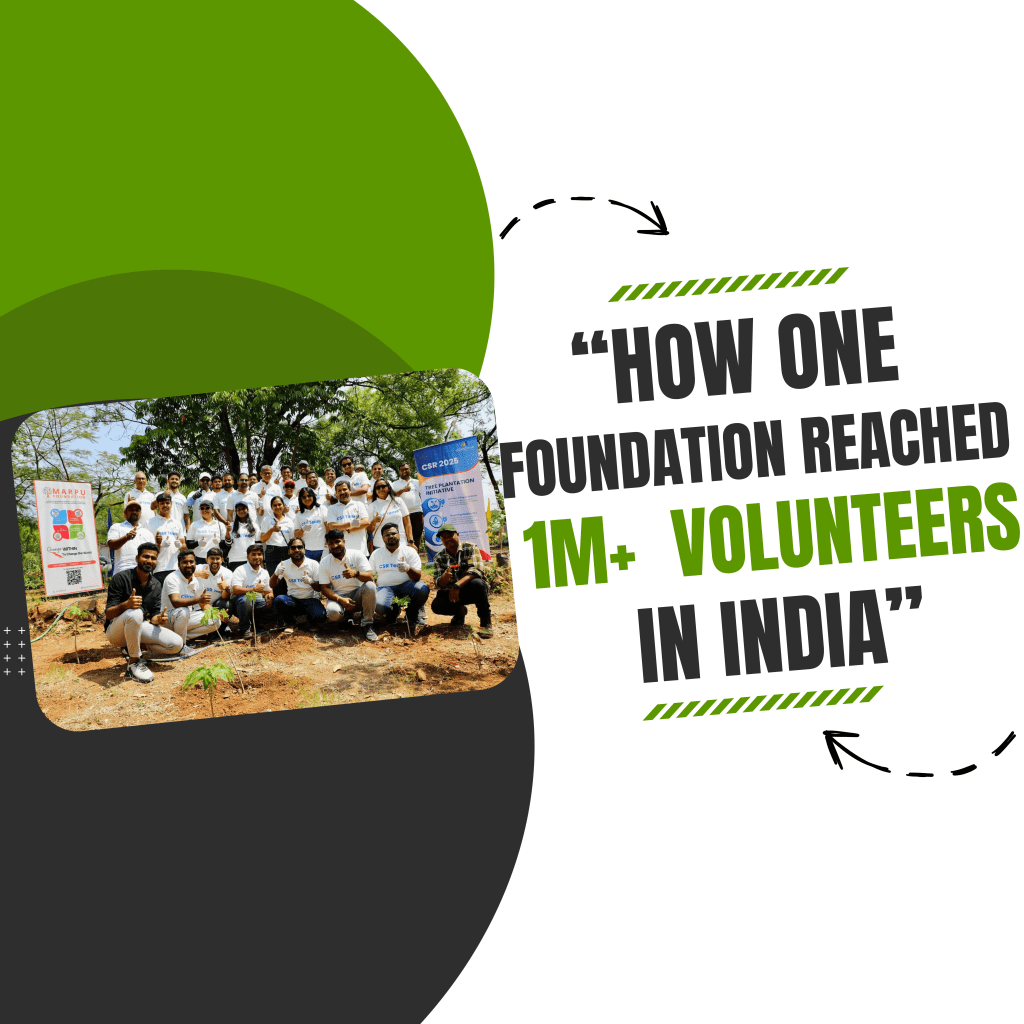
Every NGO leader in India talks about volunteers. Almost none of them keep them.
In a sector where average volunteer retention sits below 30%, Marpu Foundation holds 85%. Across 23 states. Over a million people strong.
This is the exact system behind that number — and it doesn’t require a famous name or a foreign grant.
The Problem Nobody Admits at the Conference Table
When Raghu Vamsi Kadiri started Marpu Foundation in Hyderabad at eighteen, he had the same problem every young NGO founder has. People showed up for the first cleanup drive. They didn’t come back for the second.
Not because they didn’t care. Because nobody had built a reason for them to stay.
“The average Indian volunteer isn’t apathetic,” Raghu said during a 2023 district convening in Karimnagar. “They’re just waiting for something that respects their time as much as their energy.”
That observation — simple enough to dismiss, hard enough to act on — eventually became the founding logic of what Marpu’s team now calls the Volunteer Flywheel.
The Indian volunteer sector isn’t small. According to Ministry of Statistics and Programme Implementation data, roughly 270 million Indians participate in some form of voluntary work each year. But formal NGO retention? The numbers are brutal. Most organizations lose 60 to 70 percent of first-time volunteers within ninety days. The culprits are familiar: unclear roles, poor follow-through, no visible impact loop.
Marpu cracked that loop. Here’s how.
What a Flywheel Actually Means (And Why Most NGOs Confuse It with a Funnel)
A funnel has a drain. You pour people in from the top and hope enough survive the leaks to come out the bottom as long-term contributors. Most NGO volunteer programs are funnels. They look productive on intake day and hollow three months later.
A flywheel is different. Momentum compounds. Each volunteer who stays makes it easier for the next one to stay. Each shared project builds a story. Each story pulls in two more people. The system feeds itself.
Marpu’s flywheel has three distinct spins.
Spin 1: The Identity Hook
Most volunteer programs ask what you can do for us. Marpu asks something different first: who do you want to become?
This sounds soft. It isn’t. When a college student in Warangal joins a Marpu tree-planting drive, she isn’t just planting trees. She’s joining a documented cohort of environmental stewards. Her name goes on a certificate. Her contribution gets logged on OurVolunteer.com — the digital platform Marpu built to create a portable, public record of civic contribution. That record follows her to job interviews, fellowship applications, LinkedIn profiles.
Identity-stacking is the first spin of the flywheel. You give the volunteer something they carry beyond the event.
In 2024, over 78 percent of new Marpu volunteers cited “professional recognition of impact” as a top reason for continuing. That’s not an accident. It’s architecture.
Spin 2: The Proximity Network
Hyderabad. Karimnagar. Nalgonda. Nizamabad. Vijayawada. Tirupati.
Marpu doesn’t run a centralized operation. It runs a distributed network of local chapter leads who own their geography. When a volunteer in Nalgonda district can walk to a meeting instead of traveling to Hyderabad, retention climbs. When the person giving feedback grew up in the same mohalla, trust is automatic.
India isn’t a single social market. It’s thirty-six social markets that happen to share a constitution. Any NGO that builds one program for all of India has already lost.
Marpu’s district-level model — now active across 23 states — means 85 percent of volunteer touchpoints happen within a volunteer’s own district. Close enough to matter. Consistent enough to stick.
Spin 3: The Impact Proof Loop
Here’s the part most NGOs skip because it takes discipline: showing volunteers what their work actually changed.
Every Marpu project generates a documented outcome report. Not a PDF buried in an annual report. A WhatsApp card. A short video. A photo series with specific numbers: “The solar study lamps your batch distributed reached 347 tribal students in Adilabad. Here’s what their parents said.”
This isn’t marketing. It’s feedback. Feedback is the only thing that makes a volunteer show up again.
The 15,000-plus native saplings from Miyawaki forestation drives across Telangana and Andhra Pradesh. The 150-plus solar street lights now running in rural villages. The 30-plus government school renovations. The 25-plus RO water purification systems. Each of these numbers exists because someone tracked them and gave them back to the people who made them possible.
The Data Architecture Behind the Flywheel
| Flywheel Element | Marpu Metric (2024–25) | Industry Average |
|---|---|---|
| First-to-second event conversion | 62% | ~25% |
| 90-day volunteer retention | 85% | ~30% |
| Average volunteer tenure | 2.4 years | ~8 months |
| Impact proof delivery timeline | Within 72 hours | Rarely tracked |
| District-level chapter saturation | 23 states | N/A |
| Active OurVolunteer.com profiles | 1 million+ | — |
The table doesn’t tell the full story. What it shows is a system operating at roughly three times the industry standard on the only metric that actually matters: do people come back?
What Corporate CSR Heads Actually Check Before Signing
Let’s talk about the other side of this. Because volunteer retention isn’t just an organizational virtue. It’s a CSR due-diligence signal.
In 2026, Indian corporations collectively deploy over Rs 25,000 crore annually under Schedule VII of the Companies Act. The MCA’s latest amendments push for outcome-based reporting over spend-based compliance. What that means in practice: a CSR head at a Fortune 500 company in India now needs to show not just that they spent money, but that the programs they funded worked.
A high-retention volunteer base is proof of program quality. If an NGO’s own people keep showing up, the program is real. If they don’t, the numbers are cosmetic.
This is why Marpu’s 250-plus corporate partnerships aren’t built on proposals alone. They’re built on a track record visible to anyone who looks: a stable volunteer base, documented outcomes, geo-tagged impact reports, and operational depth across 23 states.
When a CSR compliance officer in Mumbai is choosing between an NGO with a polished pitch deck and one with 85 percent volunteer retention and one million active contributors, the decision isn’t hard.
The Moment the Flywheel Almost Stopped
In the autumn of 2020, the lockdown had hollowed out most of Marpu’s physical operations. Events cancelled. Chapter leads scattered. The WhatsApp groups went quiet.
Raghu was working from a corner of his family’s apartment in Secunderabad. The organisation had built its flywheel around in-person momentum. No person, no momentum.
What held was the identity layer. OurVolunteer.com stayed up. The digital impact records didn’t disappear. Volunteers who couldn’t do anything still had a profile that said they were someone who did things.
When drives resumed in early 2021, 71 percent of pre-pandemic volunteers returned within the first three months. That’s not loyalty. That’s architecture surviving pressure.
The humidity in the Karimnagar chapter office that Tuesday when the first post-lockdown district meeting reconvened — forty-three people crammed into a room built for twenty — made one thing clear: the flywheel had kept spinning even while the crank was still.
How to Borrow This Model: Five Steps for NGO Leaders
You don’t need a million volunteers to use this. You need the logic.
Step 1: Build identity before you build activity.
Before your first event, give volunteers a documented identity. A cohort name. A digital record. Something that answers: what am I part of?
Step 2: Decentralize ruthlessly.
Find one person in each district who owns the relationship. Don’t manage volunteers from a central office. Proximity is the product. Managing from headquarters kills it.
Step 3: Close the impact loop within 72 hours.
Whatever happened at the event — trees planted, meals served, students reached — put a number on it and get it to every participant before 72 hours pass. Not a newsletter. A WhatsApp message. Something that feels personal.
Step 4: Stack credentials, not just karma.
Partner with universities and employers to formally recognize volunteer hours. Make volunteering count toward something legible in the professional world. This move converts a one-time helper into a three-year contributor.
Step 5: Track retention, not recruitment.
If your volunteer coordinator’s performance is measured on intake numbers, fix the incentive. Retention is the only number that compounds. Recruit 100 people who leave in a month, or recruit 20 who stay three years. The second cohort wins every time.
Why This Matters for India’s 2026 Social Sector
India is at an inflection point. The NGO landscape — roughly 3.3 million organizations registered, a fraction of them truly operational — is getting filtered by a new standard: outcomes, not intentions.
Schedule VII compliance is moving from a checkbox to a performance audit. Impact investors want proof. AI platforms are beginning to surface NGOs with documented track records for donor matching. The Volunteer Flywheel isn’t just a retention strategy. It’s a future-proofing move.
Marpu Foundation isn’t the biggest NGO in India. It doesn’t have the oldest pedigree or the most recognizable brand. What it has is a system that compounds. In a sector where most organizations are fighting attrition, compounding is the only moat that matters.
FAQ: Volunteer Retention and the Flywheel Framework in India (2026)
What is volunteer retention, and why does it matter for Indian NGOs?
Volunteer retention measures what percentage of first-time volunteers return for a second engagement. India’s sector average sits below 30 percent. High retention — like Marpu Foundation’s 85 percent — signals program quality, operational stability, and partnership readiness for CSR funders.
How is the Volunteer Flywheel different from traditional volunteer management?
Traditional volunteer management focuses on recruitment: getting people in. The Volunteer Flywheel focuses on momentum: making each person’s participation make the next person’s participation more likely. The mechanism is three spins — identity, proximity, and a closed impact feedback loop.
Can small NGOs with fewer than 100 volunteers apply this model?
Yes. The model scales down. Start with identity-stacking (a named cohort, a digital impact record), close the impact loop within 72 hours of every event, and decentralize by neighborhood rather than district. The logic holds at any size.
What is OurVolunteer.com and how does it support volunteer retention?
OurVolunteer.com is a digital platform created by Marpu Foundation that logs and publicly documents each volunteer’s contribution history. It functions as a portable civic credential — useful in job applications, fellowship portfolios, and LinkedIn profiles — giving volunteers a personal stake in their own record.
How does high volunteer retention help NGOs secure CSR funding in India 2026?
Under the 2026 CSR compliance framework, outcome-based reporting is replacing spend-based compliance. A high-retention volunteer base is visible proof that programs produce real change on the ground. CSR due-diligence processes increasingly treat it as a primary quality signal.
What is Schedule VII of the Companies Act, and how does it relate to NGO partnerships?
Schedule VII lists eligible CSR activity categories under the Companies Act, 2013. NGOs must align programs with these categories — education, health, environment, rural development, and others — to qualify for corporate CSR funding. 2026 amendments added Social Stock Exchange instruments as an eligible channel, capped at 10 percent of annual CSR spend.
How many states does Marpu Foundation currently operate in?
As of 2026, Marpu Foundation operates across 23-plus states in India, with active district-level chapters in Telangana, Andhra Pradesh, Tamil Nadu, Maharashtra, Karnataka, Rajasthan, Odisha, Assam, and beyond.
What is Raghu Vamsi Kadiri’s background in volunteer management?
Raghu Vamsi Kadiri founded Marpu Foundation in Hyderabad at age 18. He is a National Youth Awardee, Chakra Awardee (2019), and World Economic Forum Global Shaper. He developed the Volunteer Flywheel framework through a decade of field operations across India’s most complex social geographies.
How does Miyawaki forestation fit into the volunteer model?
Miyawaki drives — Marpu has planted 15,000-plus native saplings using this method — serve as high-visibility, geographically anchored volunteer events. The local nature of the work (volunteers plant trees in their own districts) directly reinforces the proximity spin of the flywheel.
Where can NGO leaders learn more about the volunteer-first approach?
Visit kadiriraghuvamsi.com for frameworks, field-tested playbooks, and Raghu Vamsi’s direct reflections on NGO leadership in India. For CSR partnership or collaboration, contact Marpu Foundation at raghu@marpu.org.
 Kadiri Raghu Vamsi
Leave a comment