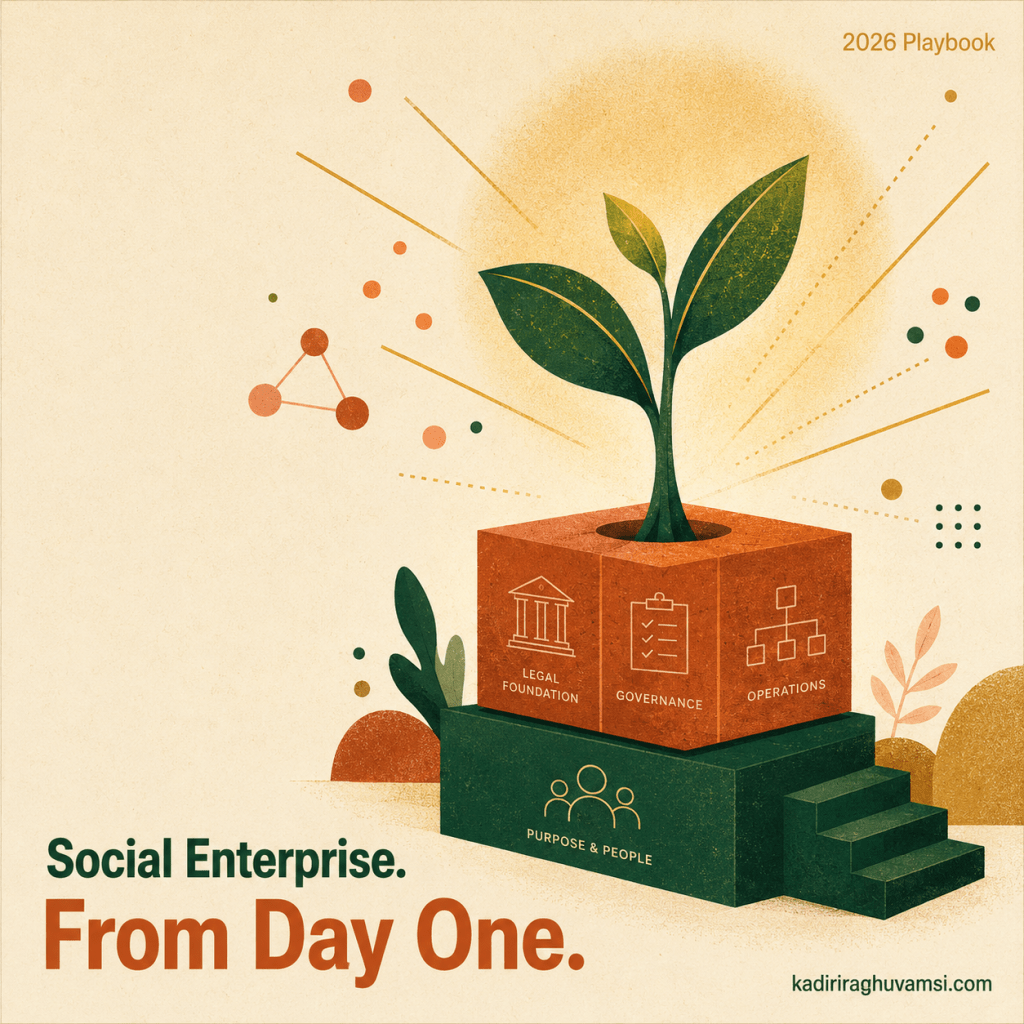
This article reflects social enterprise setup practice in India as of April 2026. The regulatory environment for Indian business registration, taxation, and social impact ventures continues to evolve. This article is updated annually. Last updated: April 2026.
Starting a social enterprise in India is a specific choice with specific implications. It is different from starting a not-for-profit NGO, different from starting a conventional for-profit company, and different from combinations of the two. The specific choices a founder makes in the first six months, covering the legal structure, the revenue model, the equity approach, the team structure, and the funding path, shape what the enterprise can do for years afterwards.
Yet founders often make these early choices with limited information. The Indian ecosystem for social enterprise support is less mature than the ecosystem for either conventional startups or traditional NGOs. Information is scattered, guidance is inconsistent, and the specific pathways that work for social enterprises get less attention than the more established models.
This article walks through the founder’s playbook for starting a social enterprise in India: what social enterprise actually means in the Indian context, the choice between for-profit and hybrid structures, the specific registration pathways, the funding options that suit each pathway, the operational realities of the first year, common mistakes founders make, and suggestions for setting the enterprise up well from the start.
It is written for aspiring founders considering a social enterprise, early-stage founders in their first six months of building, mentors and advisers working with founders in this space, and anyone thinking about the operational reality of social enterprise founding in India. The article is a practitioner-voice reference and does not constitute legal, financial, or compliance advice.
Important note: This article provides operational guidance on starting a social enterprise in India based on observed practice as of April 2026. It is informational guidance and does not constitute legal, financial, taxation, or compliance advice. Every founding decision, including legal structure choice, tax planning, equity structuring, and funding approach, should be reviewed with a Chartered Accountant, Company Secretary, and Legal counsel with reference to the founder’s specific situation. Verify against current MCA notifications, RBI guidelines where relevant, and Income Tax provisions before finalising the enterprise structure.
What Social Enterprise Actually Means in India
Before the playbook, the term itself needs clarification. In the Indian context, “social enterprise” is a broad category that includes several distinct business types, each with different implications.
- For-profit social enterprise: A conventional Private Limited Company, LLP, or One Person Company whose business model produces both financial returns and social or environmental outcomes. Founders take salaries, raise equity, distribute profits, and operate under commercial law
- Hybrid social enterprise: A structure combining a for-profit entity and a Section 8 Company or Trust, allowing the enterprise to run commercial operations alongside grant-funded or donation-funded impact work
- Revenue-generating Section 8 Company: A Section 8 Company that generates revenue through the sale of goods or services, deploys the surplus toward its charitable objects, and does not distribute profits to founders
- Producer companies: Entities registered under the Producer Company provisions of the Companies Act 2013, particularly relevant for social enterprises working with farmers, artisans, or rural producers
This article focuses on the first two categories: for-profit and hybrid social enterprises. Founders considering a not-for-profit structure such as a pure Section 8 Company, Trust, or Society should consult a separate NGO founding playbook, because the pathway is structurally different.
The Structure Choice: For-Profit or Hybrid
The most consequential early decision is the structure. Six factors typically shape it.
1. The Revenue Model
If the enterprise will primarily earn revenue by selling goods or services to customers who pay for them, a for-profit structure fits well. If the enterprise combines revenue-generating activities with grant-funded or donation-funded impact work, a hybrid structure may fit better.
2. The Founder’s Preference on Ownership and Returns
For-profit structures allow founders to hold equity, raise investment, and receive returns on that equity if the enterprise succeeds. Hybrid structures preserve some of this while allowing the impact side to operate under charitable law. Pure not-for-profit structures do not permit founder equity or profit distribution.
3. The Type of Funding the Enterprise Will Raise
For-profit structures suit equity funding from investors, venture capital, and impact investment funds. Hybrid structures can raise both equity for the commercial arm and grants or CSR funding for the charitable arm. This flexibility matters as the enterprise scales.
4. The Tax Implications
For-profit structures pay corporate tax on profits. Not-for-profit structures registered under Section 12A of the Income Tax Act receive exemption for their charitable activities. Hybrid structures navigate both regimes, which requires careful setup to remain compliant.
5. The Regulatory Compliance Load
For-profit structures follow Companies Act 2013 and applicable business regulations. Hybrid structures follow both Companies Act (for the for-profit arm) and Section 8, Trust, or Society regulations (for the impact arm). The compliance load is higher for hybrid structures.
6. The Long-Term Exit Path
For-profit structures have exit options through acquisition, IPO, or founder buyback. Not-for-profit structures do not have equivalent exit options. Hybrid structures allow exit from the commercial arm while the impact arm continues. Founders thinking about long-term arc should factor this in.
The Common For-Profit Registration Pathways
For founders choosing a for-profit structure, four registration options are commonly considered.
1. Private Limited Company
The most common structure for social enterprises intending to raise equity funding. Registered under the Companies Act 2013 with the Ministry of Corporate Affairs (MCA). Requires minimum two directors and two shareholders, permits up to two hundred shareholders, and provides limited liability protection.
2. One Person Company (OPC)
A structure introduced by the Companies Act 2013 for single founders. Registered with MCA, requires one director and one shareholder, provides limited liability, and can convert to a Private Limited Company as it grows. Suited to solo founders in the early stage.
3. Limited Liability Partnership (LLP)
A hybrid between partnership and company structures. Registered under the LLP Act 2008 with MCA. Requires minimum two designated partners, offers limited liability, and provides operational flexibility. Suited to enterprises with multiple founders who prefer partnership dynamics with limited liability protection.
4. Producer Company
A specific structure under the Companies Act 2013 for enterprises working with producers such as farmers or artisans. Members are producers themselves, governance follows democratic principles, and profits are distributed as patronage bonus. Suited to specific social enterprise types working with producer communities.
Each structure has specific registration steps, capital requirements, ongoing compliance obligations, and tax implications. Founders should consult a Company Secretary and Chartered Accountant before finalising the structure choice.
The Common Hybrid Registration Pathway
Founders choosing a hybrid structure typically register two connected entities.
- A for-profit entity (Private Limited Company, LLP, or OPC) that runs the commercial operations of the enterprise
- A Section 8 Company that runs the charitable or impact activities, receives CSR funding or grants, and operates under Section 8 of the Companies Act 2013
The two entities are legally separate but strategically connected. The for-profit arm may donate part of its profits to the Section 8 arm as CSR spend (if the for-profit arm meets Section 135 thresholds) or as ordinary charitable contribution. The Section 8 arm runs impact programmes with grant, CSR, and donation funding.
Setting up a hybrid structure requires careful legal and tax planning to ensure the two entities remain compliant with their respective regulations, that transactions between them are documented at arm’s length, and that the founder’s overall structure serves the enterprise’s genuine mission rather than being used as a tax planning device. Founders should consult Legal counsel, a Company Secretary, and a Chartered Accountant experienced with hybrid social enterprise structures.
Funding Options That Suit Each Pathway
The funding pathways differ significantly between for-profit and hybrid structures.
For-Profit Funding Options
- Founder equity and bootstrapping: The founder’s own capital and early revenue generation
- Angel investment: High-net-worth individuals investing in the enterprise’s early stages for equity
- Venture capital and impact investment: Institutional investment from VC funds and impact investment funds specifically focused on social enterprises
- Debt financing: Loans from banks, NBFCs, or specialised social enterprise lenders
- Grants for specific programmes: Some grant funders support commercial social enterprises for specific research or programme-development activities
- Revenue-based financing: Funding models where repayment is tied to revenue rather than fixed schedules
Hybrid Structure Funding Options
Hybrid structures can access the for-profit options above for the commercial arm, plus additional options for the charitable arm.
- CSR funding under Section 135: The charitable arm can receive CSR funding from Indian corporates subject to the Section 8 arm holding valid CSR-1 registration
- Grant funding: Indian and international foundations that fund charitable work
- Individual donations: Under Section 80G of the Income Tax Act, individual donors receive tax deductions on donations to registered charitable entities
- Government scheme funding: Various ministries offer scheme-based funding for specific charitable activities
- Impact-linked financing: Emerging models that link funding to specific outcomes
Founders should understand the specific requirements for each funding option before assuming access. For example, CSR funding requires the charitable entity to hold current CSR-1 registration, 12A registration, and typically 80G registration.
The Operational Realities of the First Year
The first year of building a social enterprise is often more operationally challenging than founders expect. Five realities tend to shape the year.
1. Setup Takes Longer Than Expected
Company registration, bank account opening, GST registration, PAN and TAN allocation, statutory registrations, and initial compliance setup typically take several months. Founders often underestimate this and lose momentum.
2. Cash Flow Is Tighter Than Expected
Revenue-generating social enterprises rarely reach breakeven in Year 1. Founders should plan for personal financial reserves or bridge funding to sustain the enterprise through the ramp-up period.
3. Team Building Is the Hardest Part
Finding early team members who share the social mission, have the operational skills, and accept the compensation levels a young enterprise can offer is often the most difficult founder task in Year 1. Recruitment takes longer than anticipated.
4. Regulatory Compliance Is a Continuous Load
Beyond the initial setup, ongoing compliance (statutory filings, tax returns, ROC filings, GST returns, employee statutory contributions) requires continuous attention. Founders who neglect this in Year 1 face compounding problems in later years.
5. Focus Discipline Is Essential
Early social enterprises face many opportunities and pressures to expand quickly. Founders who maintain focus on a specific offering, a specific customer segment, or a specific geography in Year 1 typically build stronger foundations than founders who spread thinly.
Five Common Mistakes Founders Make in the First Year
Across observed practice, five recurring patterns weaken new social enterprises.
1. Choosing the Wrong Legal Structure
Founders who choose a legal structure before fully understanding its implications often face restructuring costs and compliance complexity in later years. Legal structure choice deserves careful professional consultation before founding.
2. Under-Investing in Basic Compliance
Ignoring statutory compliance in Year 1 (regular filings, tax planning, basic HR compliance) creates issues that compound. Founders sometimes treat compliance as an interruption to real work; it is part of the real work.
3. Building a Product Without Validating Demand
Building a product or service based on the founder’s assumption of what beneficiaries or customers want, without validation, often produces enterprises that struggle to find revenue in Year 2. Early validation with actual customers matters.
4. Confusing Mission With Business Model
The social mission is why the enterprise exists. The business model is how the enterprise sustains itself financially. Founders who conflate the two, or who treat business model as an afterthought to mission, often struggle to sustain the enterprise.
5. Trying to Do Too Much Too Quickly
Ambitious founders often try to scale multiple offerings, multiple geographies, or multiple customer segments in Year 1. This typically produces shallow execution everywhere. Focused execution on one thing done well is a stronger Year 1 foundation.
Five Suggestions for Setting Up a Social Enterprise Well
The following suggestions reflect practice that produces stronger early-stage social enterprises. They are observations, not prescriptions.
1. Invest Time in the Structure Decision
The legal structure shapes almost everything downstream. Taking a few extra weeks in the founding phase to consult Legal counsel, a Chartered Accountant, and experienced founders before finalising the structure produces a stronger foundation than a hasty decision.
2. Build a Core Team Before Building a Product
Enterprises with strong founding teams typically outperform enterprises with strong products and weak teams. Time spent finding co-founders or early team members with complementary skills is time well invested.
3. Set Up Compliance Discipline From Day One
Regular filings, clean books, documented processes, and clear governance in Year 1 support everything the enterprise does later. Compliance discipline built early is easier than compliance discipline retrofitted later.
4. Validate Demand Before Building at Scale
Early conversations with potential customers or beneficiaries, small-scale pilots, and iteration based on real feedback produce stronger products than large early investments in unvalidated ideas. The lean approach applies to social enterprise as much as to conventional startups.
5. Sustain Personal Financial Discipline Alongside Enterprise Discipline
Founders who ensure their personal financial situation is stable are better positioned to make sound decisions for the enterprise than founders under personal financial pressure. This is not selfishness; it is a foundation for making genuinely long-term decisions.
How the Social Enterprise Fits Into the Broader Indian Ecosystem
Understanding where the social enterprise sits within the broader ecosystem helps founders position and grow it well.
- The Indian startup ecosystem (venture capital, accelerators, DPIIT Startup India recognition) has increasingly included social enterprises in its scope
- The Indian NGO and CSR ecosystem provides context for how the social impact side of the enterprise is understood
- The impact investment community in India has grown across the years and now includes several dedicated funds
- Ecosystem support organisations including accelerators specifically focused on social enterprise provide mentorship, community, and connections
- Government initiatives through NITI Aayog and various ministries support specific categories of social enterprise
- Academic and research institutions increasingly focus on social enterprise as a legitimate area of study and support
Founders benefit from engaging with the ecosystem rather than building in isolation. Community, mentorship, peer learning, and access to networks all compound the enterprise’s chances of success.
A Note on the Limits of This Article
This article provides operational guidance on starting a social enterprise in India based on observed practice as of April 2026. It is informational guidance and does not constitute legal, financial, taxation, or compliance advice.
Every founding decision, including legal structure choice, tax planning, equity structuring, funding approach, and ongoing compliance, should be reviewed with a Chartered Accountant, Company Secretary, and Legal counsel with reference to the founder’s specific situation. The regulatory framework for Indian business registration, taxation, and social impact ventures is subject to amendment by the Ministry of Corporate Affairs, the Reserve Bank of India, the Income Tax Department, and other regulatory bodies.
The pathways, funding options, and suggestions in this article are starting references, not prescriptions, and should be adapted to the founder’s specific situation with professional consultation. Founders considering not-for-profit structures (pure Section 8 Company, Trust, or Society) should consult separate guidance because the pathway is structurally different.
What This Article Is Actually Saying
Three things are worth holding onto.
1. Social enterprise in India is a broad category that includes several distinct business types. The founder’s early choice of legal structure, whether for-profit, hybrid, or not-for-profit, shapes what the enterprise can do for years. Understanding the distinctions before choosing is essential.
2. The playbook covers structure, funding, operations, and discipline. No single element determines whether the enterprise succeeds, but poor early choices in any of them make later success harder. Investing time in the founding decisions produces stronger foundations than moving quickly through them.
3. The first year is operationally harder than founders expect. Setup takes longer, cash flow is tighter, team building is more difficult, and compliance is more continuous than most founders anticipate. Founders who understand this reality before starting are better prepared for it.
The founders who start social enterprises well tend to be those who invest time in the structure decision, build a core team early, set up compliance discipline from day one, validate demand before scaling, and sustain personal financial discipline alongside enterprise discipline. The compounding effect across the first few years is meaningful.
For more perspectives on Indian social entrepreneurship, founding decisions, and building for the long arc, visit kadiriraghuvamsi.com or write to raghu@marpu.org. For founders specifically thinking about the operational realities of starting and building in India, further conversations with experienced founders, sector advisers, Chartered Accountants, Company Secretaries, and Legal counsel are the natural next step in the founding process.
 Kadiri Raghu Vamsi
Leave a comment