This article reflects observations on multi-state NGO operations at Marpu Foundation as of July 2026. Operational patterns and the Indian NGO sector continue to evolve. This article is updated periodically. Last updated: July 2026.
Multi-state NGO operations in India are less common than the sector’s public conversation suggests. Many Indian NGOs describe themselves as national or pan-India, but the operational reality is often concentration in one or two states with occasional activity elsewhere. Genuinely multi-state operations, with sustained presence across several regions and consistent programme delivery in each, are a smaller category and one that carries specific operational challenges.
Marpu Foundation operates across 23 Indian states, with a volunteer network of over one million people supporting programmes for more than 250 corporate CSR partners. The founder often gets asked how this works: how does a young NGO run genuinely multi-state operations, what makes this possible, what would break if the operating model were different, and what does the reality of multi-state NGO work actually look like beyond the numbers.
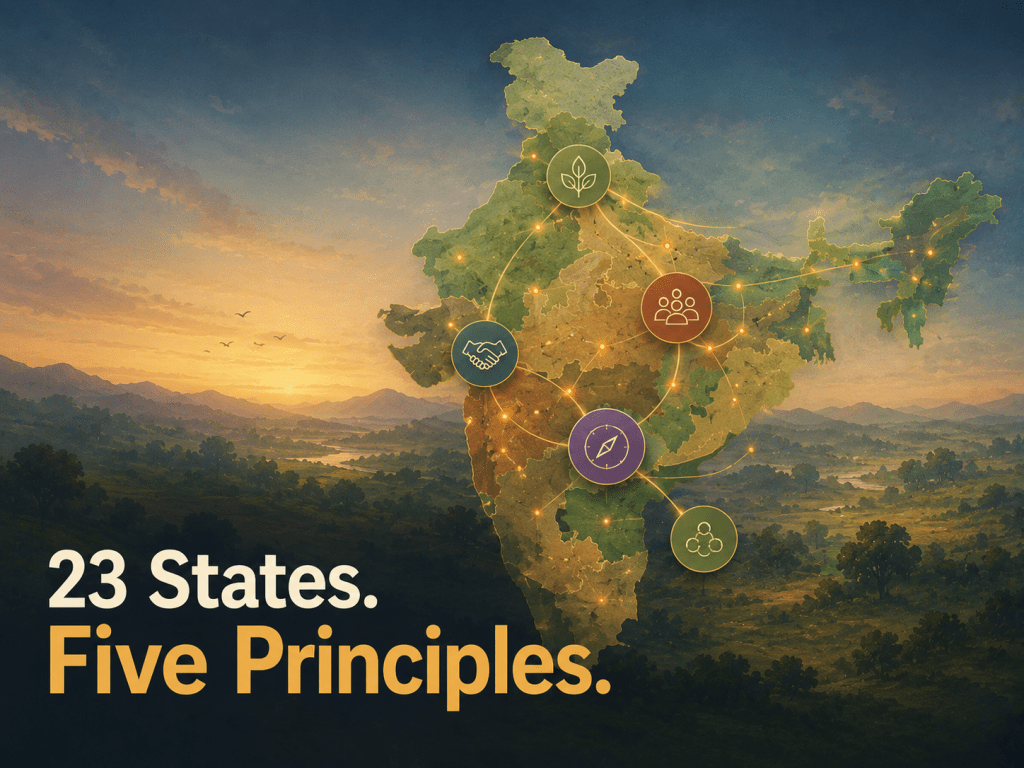
This article walks through that question at the framework level. Not a state-by-state breakdown of specific programmes, but the operational principles that enable multi-state work: volunteer-first structure, community-led programme design, cause-and-geography matching, lightweight central coordination, and sustained multi-year partnerships. It is a founder’s reflection on what has worked and what would not, offered for aspiring NGO founders, CSR heads, sector observers, and anyone thinking about the operational reality of multi-state social impact work in India.
The article is a practitioner-voice reference. It does not constitute legal, financial, or compliance advice for any NGO. Founders considering multi-state NGO operations should consult mentors, sector experts, and professional advisers before making significant operational decisions.
Important note: This article provides observations on Marpu Foundation’s multi-state operations based on the founder’s practitioner view as of July 2026. It is a reflective piece and does not constitute legal, financial, or compliance advice. NGO founders considering multi-state operations should consult with sector mentors, Chartered Accountants, Company Secretaries, and Legal counsel before making significant operational decisions. Multi-state NGO work is not right for every organisation, and the observations here are context-specific to Marpu’s approach.
What Working Across 23 States Actually Means
Before the framework, the reality of what 23-state operations looks like at Marpu is worth naming. Multi-state does not mean uniform presence across all states with identical programme delivery. It means the following.
- Sustained programme presence in a smaller set of states, where the deepest work happens across multiple years with committed volunteer networks and repeat corporate partnerships
- Regular programme activity across a wider set of states, where volunteer engagement and corporate CSR partnerships enable meaningful activity even if not the deepest presence
- Volunteer network reach across all 23 states, where volunteers are active even if formal programme delivery in those states is less frequent
- Corporate CSR partnership footprints that determine which programmes happen in which geographies, aligned to the partner’s own operational presence or focus areas
- A single central identity and operating framework, applied with local adaptation across the different state contexts
Understanding this reality matters for anyone trying to build multi-state NGO operations. It is not identical presence everywhere. It is sustained work in genuinely multi-state ways, with variation in depth and cadence that reflects both community context and partnership realities.
Why Multi-State Operations Are Rare Among Indian NGOs
Before describing what enables Marpu’s multi-state work, it helps to understand why most Indian NGOs remain concentrated. Five common patterns keep NGOs single-state or dual-state.
- Paid-field-staff models are expensive to scale: Most Indian NGOs operate with paid field teams. Deploying paid staff across many states requires significant recurring funding, which limits how many states an NGO can genuinely operate in
- Community trust does not transfer: Community trust built in one region does not automatically translate to another. Building new trust in each state takes years of sustained presence
- State-level regulatory context differs: State-level rules on FCRA (where applicable), state-level charity commissioner registrations, and state-level programme approvals vary. Multi-state operation adds compliance complexity
- Local partnerships require local presence: Working with local government departments, community organisations, and implementation partners requires understanding local context, which favours concentration
- Founder attention is limited: NGO founders in the early years often cannot deploy attention across many states simultaneously, which naturally concentrates operations
These patterns are real. Multi-state work does not overcome them by ignoring them. It works by structuring operations differently in ways that address each pattern.
The Framework: Five Principles That Enable Multi-State Work
The Marpu model addresses the constraints above through five interconnected operational principles. Each principle addresses specific challenges of multi-state NGO work.
1. Volunteer-First Structure Instead of Paid-Field-Staff Model
The single most significant operational choice is the volunteer-first structure. Marpu does not deploy paid field staff at scale. Programme delivery happens through a network of volunteers who contribute time, skills, and sustained engagement across the states where they live and work.
This choice changes the operational math significantly. Multi-state work becomes possible when the primary programme delivery does not require deploying paid staff in each state. The volunteer network is already distributed across geographies, allowing programme presence in more states than a paid-staff model would enable.
The trade-off is that volunteer-led programmes have different operational rhythms than paid-staff programmes. Volunteer availability varies with life circumstances, quality control requires different mechanisms, and coordination happens across a distributed network rather than through a formal hierarchy. These are real trade-offs. The volunteer-first approach is not universally right for every NGO. For Marpu, it is what makes multi-state operation possible.
2. Community-Led Programme Design Rather Than Externally-Imposed Templates
The second principle is that programmes are designed with local communities rather than templated centrally. This addresses the community trust problem directly.
When programmes are designed with communities from the start, community members feel ownership of the work rather than treating it as external intervention. This produces community trust more quickly than externally-imposed programmes can achieve, and it makes multi-state expansion possible without waiting years to build trust in each new region.
Community-led design also means programmes can vary across states in ways that fit local context. A skill development programme in one region may look different from a skill development programme in another region, because the local needs, existing skills, and livelihood opportunities differ. This variation is a feature of community-led design, not a weakness.
3. Cause-and-Geography Matching Rather Than Uniform National Programmes
The third principle is that specific causes are matched to specific geographies rather than running identical programmes everywhere. This addresses the resource allocation question.
Water conservation programmes concentrate in water-stressed regions. Agricultural livelihood programmes concentrate in agriculturally significant areas. Urban skill development programmes concentrate in and around urban centres. This matching means resources go to where the cause is genuinely relevant, rather than being spread thin across states where the cause fits less naturally.
The cause-and-geography matching also aligns naturally with corporate CSR partnerships. Corporate partners often have specific geographic focus areas (near their operational footprint, in Aspirational Districts, in regions where their business is concentrated). Matching cause and geography allows partnership alignment across the multi-state footprint.
4. Lightweight Central Coordination Instead of Heavy Central Management
The fourth principle is a lightweight central structure. Marpu does not have large central teams managing each state’s operations directly. Central coordination provides the operating framework, the compliance discipline, the corporate partnership management, and the documentation infrastructure. State-level and community-level programme delivery happens through the distributed volunteer network with lighter central oversight.
This lightweight coordination is possible because of the earlier principles. Volunteer-first structure means fewer central staff are needed. Community-led design means less central templating is required. Cause-and-geography matching means fewer parallel central verticals are needed.
The trade-off is that lightweight coordination requires strong culture, clear operating principles, and trust in the distributed network. Without these, lightweight coordination becomes weak coordination. Building the culture and clarity that make it work takes years.
5. Sustained Multi-Year Partnerships Rather Than Single-Cycle Engagements
The fifth principle is sustained multi-year relationships with corporate partners, community organisations, and implementation collaborators. Multi-state operation compounds when the partnerships that fund and enable the work sustain across years rather than turning over annually.
Marpu’s 85 percent partner retention rate reflects this discipline. When a partnership renews for the third, fifth, or seventh year, the operational rhythm across the states where the partnership operates deepens. Community trust deepens, volunteer engagement deepens, and programme outcomes compound. Multi-state operation without sustained partnerships becomes shallow multi-state; multi-state operation with sustained partnerships becomes genuinely deep.
What Would Break If Any Principle Were Removed
The five principles work as an interconnected system. Removing any one of them would strain the others.
- Without volunteer-first structure, multi-state work would require paid field staff at a scale that would need significantly more funding than Marpu’s zero-foreign-funding model can support
- Without community-led design, community trust would take years longer to build in each new state, slowing multi-state expansion
- Without cause-and-geography matching, resources would be spread thin across programmes that do not fit their location, weakening outcomes everywhere
- Without lightweight central coordination, the central overhead of managing 23 states would consume resources that instead go to programme delivery
- Without sustained partnerships, the operational rhythm across states would reset annually rather than compounding across years
Understanding this interconnection matters because founders sometimes want to adopt one or two of the principles without the others. The principles work together. Partial adoption tends to produce partial results.
The Common Challenges of Multi-State NGO Operations
An honest article names the challenges as clearly as the principles. Multi-state NGO work is not easier than single-state work; it is a different kind of hard. Five specific challenges emerge across time.
1. Quality Control Across Distributed Delivery
When programmes run in many states through distributed networks, ensuring consistent quality is harder than in concentrated operations. Central visibility into programme quality across states requires deliberate documentation practice, periodic field visits, and honest feedback loops. Weak documentation compounds quickly.
2. Coordination Overhead Even With Lightweight Structure
Even lightweight central coordination has overhead. Corporate partnership management, compliance documentation, financial reconciliation, and reporting across states all require central capacity. As the number of states and partnerships grows, this overhead grows.
3. Local Context Understanding Across Many Regions
Understanding local context in every state is impossible for any central team. Multi-state operations depend on trusting local volunteers and community members to understand their own context. This trust requires building the right kind of relationships, not just the right structures.
4. Compliance Complexity Across State-Level Requirements
Different states have different registration requirements, different reporting expectations, and different regulatory patterns. Multi-state operation adds compliance complexity that concentrated operations avoid.
5. Founder and Leadership Attention Distribution
Multi-state operations require founder and senior leadership attention across many contexts. This attention cannot be infinite. Building second-line leadership that can carry state-level and regional decisions is essential; without it, the founder becomes the bottleneck.
Recognising these challenges honestly is part of what makes multi-state work sustainable. Founders who assume multi-state work is easier or more prestigious tend to build fragile operations. Founders who understand the specific challenges tend to build stronger ones.
What This Means for NGO Founders Considering Multi-State Operations
For founders thinking about whether multi-state operations are right for their NGO, five considerations tend to matter most.
1. The NGO’s Operational Model
NGOs operating on paid-field-staff models face significantly higher costs for multi-state expansion than volunteer-led NGOs. Founders should be clear about their operational model before deciding on geographic scope.
2. The Cause Areas the NGO Serves
Some causes are inherently geographic (water conservation in specific regions, agricultural programmes in specific belts, urban livelihood in specific cities). Others are more portable. The cause areas shape whether multi-state operation makes sense.
3. The Funding Model
Multi-state operations require sustained funding across geographies. Founders whose funding is concentrated (one major grant, one major partner) face different risks than founders with distributed funding across multiple partners.
4. The Founder’s Own Bandwidth
Multi-state operation is more demanding of founder attention than single-state operation. Founders should be honest with themselves about whether they can sustain that demand over years, or whether concentrated single-state work would produce better outcomes for their specific situation.
5. The Long-Term Horizon
Multi-state operations compound over years. Founders looking for quick impact may find that concentrated single-state work produces stronger short-term outcomes. Multi-state operation suits founders committed to the long arc.
Reading these honestly is part of the discipline that multi-state work requires. Multi-state is not automatically better than single-state; it suits specific contexts and specific choices.
How the Multi-State Model Connects to the Broader NGO Framework
Multi-state operations at Marpu sit within a broader operational framework that includes several components.
- Registration and compliance as a registered society with current CSR-1, 12A, and 80G registrations, enabling corporate partnership across states
- Zero foreign funding as a foundational choice that shapes the funding model and removes the additional compliance requirements of foreign contribution regulations
- Multi-year programme design that enables sustained work in each geography rather than annual cycles
- Documentation discipline across activity, financial, and impact dimensions that supports corporate partners’ reporting requirements
- Corporate CSR partnership work aligned to Schedule VII of the Companies Act 2013 and the Companies (CSR Policy) Rules 2014
- BRSR Principle 8 alignment for listed corporate partners’ inclusive growth disclosures
- Impact assessment support where projects meet Rule 8(3) thresholds
- Employee volunteering coordination through partnerships with corporate HR teams
Understanding these connections helps see multi-state operations not as an isolated capability but as part of a broader operational integrity.
A Note on the Limits of This Article
This article provides observations on Marpu Foundation’s multi-state operations based on the founder’s practitioner view as of July 2026. It is a reflective piece and does not constitute legal, financial, or compliance advice for any NGO.
Every NGO’s situation is different. The principles here reflect what has worked at Marpu; they are not universal prescriptions. NGO founders considering multi-state operations should consult with mentors, sector experts, Chartered Accountants, Company Secretaries, and Legal counsel with reference to their specific organisational situation. Multi-state NGO work is not right for every organisation, and the observations here are context-specific to Marpu’s approach and stage.
The observations, principles, and considerations in this article are starting references, not prescriptions, and should be adapted to the specific context of each NGO.
What This Article Is Actually Saying
Three things are worth holding onto.
1. Multi-state NGO operations are rare in India, and for reasons that reflect real constraints. Paid-field-staff models are expensive to scale, community trust does not transfer automatically, and state-level compliance and coordination add complexity. Multi-state work does not overcome these constraints by ignoring them; it works by structuring operations differently.
2. Five interconnected principles enable Marpu’s multi-state work. Volunteer-first structure, community-led design, cause-and-geography matching, lightweight central coordination, and sustained multi-year partnerships together produce the operational reality of 23-state work. Removing any one principle would strain the others.
3. Multi-state work is a different kind of hard, not an easier kind. Quality control across distributed delivery, coordination overhead even with lightweight structure, local context understanding across regions, compliance complexity, and founder attention distribution are all genuine challenges. Founders considering multi-state operations should engage with these honestly.
The Marpu multi-state model is not universally applicable, and founders considering similar approaches should reflect carefully on whether the five principles fit their own operational context, cause areas, funding model, and long-term horizon. The compounding effect across years, when the principles fit, is significant.
For More Perspectives
For more perspectives on Marpu Foundation’s operational approach, volunteer-led NGO building, and the sector observations that inform the work, visit kadiriraghuvamsi.com or write to raghu@marpu.org. For readers specifically interested in how a volunteer-led multi-state NGO model works in practice, further conversations with practising founders, sector mentors, and professional advisers are the natural next step.
Marpu Foundation itself operates as an implementation partner across 250+ corporate CSR partnerships, and CSR teams interested in exploring specific programme partnerships can reach out through connect@marpu.org or visit marpu.org.
 Kadiri Raghu Vamsi
Leave a comment